What is Service Learning?
CSULB's policy on Service Learning states that service learning is a high impact teaching approach utilizing community-based experiential learning to connect theory and practice through critical reflection. Service Learning emphasizes learning through community service activities that are fundamental to course outcomes.
Service Learning provides benefit to students as well as community partners by promoting sustainable campus-community relationships that enhance student learning and address community-identified needs. Students develop their academic and critical thinking skills, gain a deeper understanding of course content, and develop an enhanced sense of civic engagement. Service Learning benefits both the campus and the community by developing a culture that promotes civic engagement, deepening student learning, meeting community-identified needs, and by forming mutually beneficial partnerships that expand opportunities for our campus to contribute to the public good.
At the beginning of the semester, your service learning professor will provide a list of pre-approved sites that will fit best with your course curriculum. After going through the organization's descriptions and task, you would then reach out to the site and see if they currently have the capacity to accept you at their site. Once you are approved, you will go on to S4 @ The Beach to start your placement process.
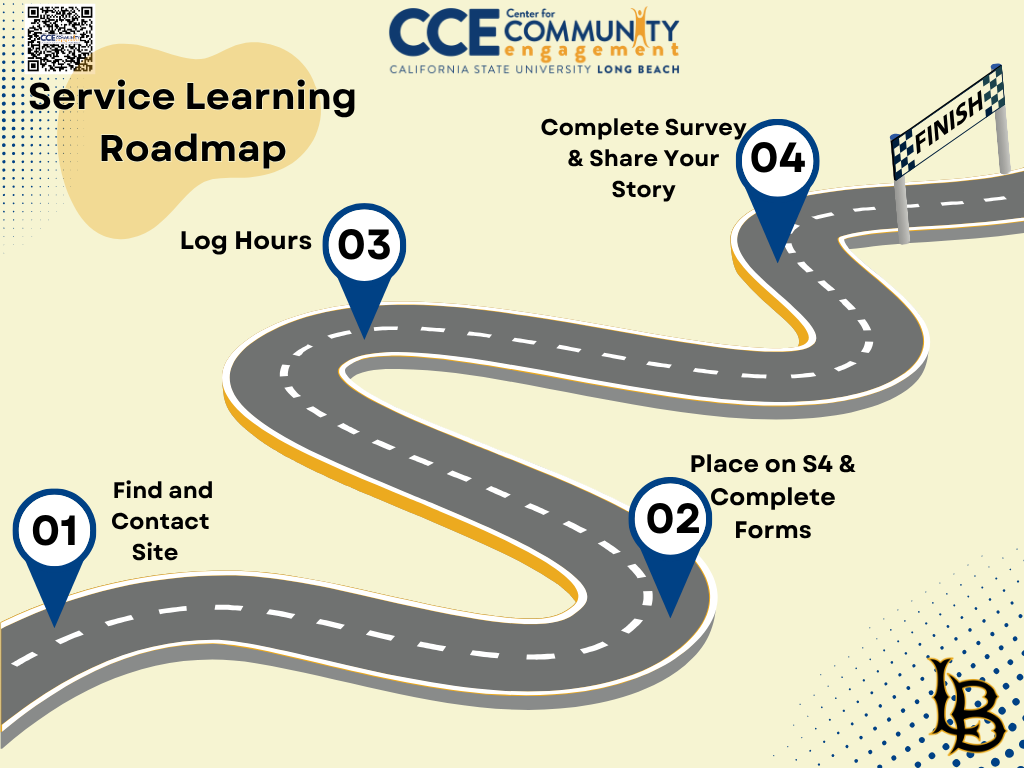
Click here for a visual on the Student Learning Roadmap
Service Learning Courses:
| Course Title | Course Description: |
| ART 375: Art Social Action Global Perspective | This course examines the interconnections among global processes and global social problems from the perspectives of art and sociology. It analyzes historical, geographical and gender, racial, and ethnic components of these problems; and the role of art to promote social change. In addition, this course will examine in depth the relationship between social practice and community-based art education with a culminating 20-hour service-learning/public art project that involves community action. |
| ART 401/501: Cross-clt Comm-based Pract Art | A study of the diversity of theory and practice in art and art education as understood in and across cultures. Application of the California Visual and Performing Arts Framework for art education to the integration of content from art history, art production, theory and criticism, and aesthetic viewpoints reflecting a variety of racial, ethnic, linguistic, gender, sexual, cultural and cross-cultural perspectives. This course will also address issues of culturally appropriate practice for understanding art across cultures. |
| ART 415: On Site Studies in Art Education | A study of the diversity of theory and practice in art and art education as understood in and across cultures. Application of the California Visual and Performing Arts Framework for art education to the integration of content from art history, art production, theory and criticism, and aesthetic viewpoints reflecting a variety of racial, ethnic, linguistic, gender, sexual, cultural and cross-cultural perspectives. This course will also address issues of culturally appropriate practice for understanding art across cultures. |
| DANC: Study Abroad Arts Education and Social Practice | This study abroad course immersed students in South African communities, offering experiential learning that combines arts education with social practice. This course explored interdisciplinary approaches, integrating artistic, cultural, and high impact practices. Students gained a deep understanding of South Africa’s history and sociocultural norms while learning how arts-based engagement can positively impact communities. They collaborated with NGOs, local artists, and community members to create arts-based workshops, fostering meaningful relationships and ethical community engagement. |
| THEA 418: Theatre of Community Engagement | This course uses myriad theatre practices as a tool to collaborate with local Long Beach organizations. Students employ immersion and performance as conventions to explore the potency of theatre and social change. Students train in the diversified methodologies of Theatre of the Oppressed, Applied Theatre, Drama Therapy, Meisner, and the Cornerstone model of community-based storytelling. The primary objective is to train and equip students with the skills, experiences, and language necessary to foster dialogue and creative alliance within Long Beach organizations. Students will contextualize and build community-specific drama classes, drawing from research and the application of techniques established. |
| Course Title | Course Description |
| CDFS 419: Family Life Education | Concepts, principles and paradigms in family life education will be explored in this course. The focus of the course is on planning, implementing, and evaluating family life education programs. Gender, ethnicity, and diversity issues as they relate to family life education will be stressed. Contemporary issues confronting individuals and families will be addressed while working with organizations that are supporting family life and education. |
CRJU 110: Justice Research and Writing | CRJU 110 introduces students to research, writing, and reasoning in a criminal justice framework AND provides students with immersive opportunities to connect their developing library and electronic research skills with experiential hands on learning. The purpose of this connection is to develops the skills needed to conduct and properly cite library and electronic research for social scientific and legal sources and use them to make persuasive oral presentations and write papers, case briefs, and reports commonly used in the justice professions. |
| CRJU 690: S Topics Criminal Justice | This course explores social justice, including broad conceptualizations of social justice; exploration of human rights, race, culture, poverty, privilege and identity in social justice; and impact of current world events (e.g. the global pandemic, civil unrest, etc.) to social justice organizations and services. Central to this course is impact. The essence of advanced courses in Criminal Justice is the hands-on acquisition of skills and informed approaches to current challenges and events, often learned through doing or seeing something firsthand. In this course, we will explore best practices in social justice and relate those to current challenges and innovative approaches in the pandemic. |
| GERN 400: Perspective on Gerontology | The purpose of this course is to investigate the continuous impact of gerontology by reviewing the worldwide phenomena of aging and by comprehending the profound implications our nation is facing by such dramatic demographic shift. Through an emphasis on getting to know the paradigm shift in our understanding of aging, we will discuss academic ideas relevant to the real-world application. Using an interdisciplinary approach, bio-physiological, psychological, and sociological aspects of aging are discussed. More specifically, through online activities, we will explore, analyze, and evaluate the impact of aging on gains and losses in physical and mental health, interpersonal well-being, social roles, personality, and stress; larger social, cultural, and economic issues including retirement, housing, and public policy are also analyzed. |
| NUTR 461/561: Community Nutrition | This upper division and graduate level course provides an understanding of community nutrition programs' development, a foundation in public health and epidemiology, dietary guidelines and policies in the United States, and development of theory- and evidence-based program strategies for nutrition interventions at three levels (build awareness, change lifestyles, and create a supportive environment). Students will also conduct a survey of nutrition programs in the community while using techniques of program planning, implementation, management, and evaluation. |
| NUTR 470/570: Applied Sports Nutrition | Students apply evidence-based sports nutrition principles through hands-on experiences with athletes and community organizations. Service-learning activities include nutrition education, wellness programming, and nutrition assessment that support healthy and active lifestyles. |
| NUTR 531: Advanced Community Nutrition | The primary goal is for students to gain knowledge and skills related to a variety of community nutrition topics, including public health, chronic disease disparities, community needs assessments, and educational material development. A secondary goal is to plan, conduct, and evaluate a community nutrition research project while integrating key components of community nutrition practice, including social and cultural competence, working in collaborations and partnerships, and using community-based participatory approaches. |
| REC 468: Sustainable Tourism Plan & Dev | Description unavailable |
| Course Title | Course Description |
| ANTH 155: Medical Tech & Human Bodies | Medical Technologies & Human Bodies takes students on a holistic exploration of the intricate relationship between medical technologies and the human body. The instructor guides students through the complex web of social, political, and historical factors that shape medical dilemmas and breakthroughs. This course equips students to champion human welfare. Structured service projects provide hands-on experience, allowing students to address real-world health disparities and local challenges while collaborating with organizations dedicated to making a difference. |
| ANTH 416/516: Urban Anthropology | Urban enthusiasts will find their passion ignited in ANTH 416/516. This course charts the evolution of urban theory in the United States and around the world. It delves deep into the symbolic and cultural construction of urban spaces, examining the profound sense of place cultivated through community activities and social interactions. To enrich their understanding, students engage directly with local community partners and organizations. |
| ANTH 417: Applied Anthropology | Anthropology 417/517 is intended to serve as a core course in CSULB’s applied anthropology program. One of the objectives of this course is to ensure that students are proficient in the language and practices of anthropology, as a broad discipline. Moreover, this course takes students into the specific arena of anthropology as an applied practice with its own distinct ideas, theories, and methodologies. This course aims to familiarize students with the history and development of applied anthropology, the similarities and differences between standard and applied research, and the wide range of topics that applied anthropologists work with - both as researchers and practitioners. Students in this course will examine ethical and professional issues that academic and practicing anthropologists address, and consider what working anthropologists confront within specific domains of practice |
| ANTH 428/528: Historical Ethnography | Historical Ethnography introduces students to historical ethnography—an interdisciplinary research approach that combines participant observation, interviews, and archival analysis. It traces the rise of historical ethnography as a specialized field, equipping students with key theoretical and methodological tools for documenting cultural change processes. Students collaborate with Long Beach community partners on research projects that construct inclusive community narratives. |
| ANTH 431/531: New Media Ethnography | New Media Ethnography is a bridge between anthropology, film, and human-centered design. This course challenges students to leverage cutting-edge technologies to address community-identified needs. Through collaboration with community groups and organizations, students are empowered to tackle pressing social issues and drive positive change. This course also offers hands-on training in applied visual anthropology, enabling students to create media products that contribute to community betterment. |
| ASAM 121: Contemporary Issues in Asian America | Focusing on Intergenerational Trauma and Community Healing, the course engages with Asian American communities in Orange County and Los Angeles County nonprofit organizations that serve Asian American youth to understand how historical marginalization, model minority stereotypes, and the triangulation of Asian Americans pervade interpersonal, familial, and community relationships. Specifically, students will explore how mental health issues, such as behavioral and drug addictions—often invisible obstacles experienced by Asian American youth—result from ethnic stratification and U.S. racialization processes. They will learn about how these issues are addressed by community organizations and resources and gain experience working directly with community members and organizations through observational hours, interviews with community organizers, and event programming with community organizations. |
| ASAM 334: Cambodian American Experience | This course employs a “learning by doing” model in which students engage in the cultural life of Cambodians in Long Beach as a lens into the varied experiences of being Cambodian American. Students will use their fieldwork experience and application of their research to explore their identities based upon their social positions (i.e., race, ethnicity, gender, generation, class, nationality, etc). To explore such topics as identity, gender, generation, and culture change, students will employ anthropological techniques in a Community Service Learning Field Project (CSL-FP). To prepare and ground students in various perspectives on the Cambodian American experience, the course also includes guest speakers and community tours. Though these interactive activities, students will become aware of the dynamic and complex workings of culture, history, memory and community. |
| CHLS 350: The Latinx Population in the U.S. | Through a partnership with the Garifuna Museum of Los Angeles, students examine Latinx experiences, migration, identity, and social institutions. Service-learning activities connect course concepts to community knowledge while fostering critical reflection on equity and social change. |
| CWL 161: Reading the World | Students examine issues of power, identity, and social justice through literature and community engagement. Service-learning experiences help students connect critical reading and cultural analysis to real-world community issues and civic action. |
| CWL 440: Topics in Latin American Literary Study | Students explore Latin American literature, culture, and identity through community engagement with local cultural spaces and organizations. These experiences connect literary analysis with civic learning, cultural understanding, and community dialogue. |
| Course Title | Course Description |
| ENGL 444: Literature and Environment | This course is a Service Learning GE capstone—students will perform 20 hours of service with a community partner over the course of the semester, about 2 hours per week for 8-10 weeks. Course readings will cover environmental ethics and ecocriticism, and we will read nonfiction essays, poetry, and speculative fiction that addresses environmental issues such as global warming, extinction, traditional ecological knowledge, pollution, and environmental justice. These readings will be the basis for the Imaging Climate Change (ICC) group projects, other writing assignments, and the final exam. |
| ENGL 482: Literature for Adolescents | This course provides a survey of literature suitable for adolescents with discussion of the adolescent reader. It explores criteria and sources for selecting adolescent literature and literary theory at the high school level field with experience at the secondary school level and effective methods of classroom presentation of works from the genre. |
| HIST 482: Recent Amer Environmental History | This course examines the interaction between humans and the natural world in the United States from the late nineteenth century to the present. Students will be expected to develop an historical understanding of the major themes of modern American environmental history: relationships between human activity and pollution in American cities, emergence of reform movements and environmental regulation, relationship between increasing urban growth and increasing environmental concern, motives and mechanics of resource management, and the rise of environmental politics. |
| JOUR 471: Public Relations Mgmt & Campaigns | In this course, students will work in agency situations to develop a business proposal for clients involving formal written plans and oral presentations. Students will serve as consultants and develop programs for organizations. Through hands-on experience, students develop real-world campaign proposals, learning to understand diverse audiences and apply ethical, culturally responsive communication strategies. The course highlights the role of public relations in advancing civic responsibility and supporting meaningful community engagement. |
| LING 593: Practicum in Tesol | This service-learning course bridges linguistic theory and teaching practice to prepare graduate students for careers in TESOL (Teaching English to Speakers of Other Languages). In partnership with the Long Beach Public Library and other community nonprofit organizations, students provide 20 hours of community-based English instruction to immigrants, refugees, and other underserved populations. Through lesson planning, classroom management, and adapting teaching methods for diverse learners, students gain essential, real-world teaching experience. The course fosters civic engagement, cultural exchange, and social responsibility, while offering vital English support to community members seeking greater opportunities for employment, education, and social integration. |
| POSC 401, WGSS 401/204: Women in Political Theory | POSC 401/WGSS 402 tracks the rise of feminist political theory and practice both within and against the history of Western political thought though the examination of canonical texts, movement texts, speeches, documents, and scholarship. Study of the evolution of feminist arguments in Western political thought and the process by which gender has come to be regarded as a critical category equal in importance to race, class, ethnicity, sexual orientation, and religion. It seeks to combine the academic component of the course with hands-on experience outside the classroom so that students can write a paper that combines theory and praxis. |
| POSC 450: Comparative Political Movement | Political movements are often the most dynamic and transforming of all political phenomena. Why do political movements occur? Who joins them? What sorts of ideologies have justified and motivated political movements? How have various social groups been affected by political movements? What are the political, economic, and social consequences of political movements? Do the dynamics of political movements differ in democracies and non-democracies? This course explores answers to these questions, through a comparative examination of political movements around the world, and through the personal experience of working with a local political movement organization. In so doing, it seeks to encourage students to become more active and engaged citizens. |
| PSY 375: Community Psychology | Therefore, the primary goal for this course is to introduce you to and give you practice using a community psychology perspective. As a field, community psychology is interdisciplinary in focus – it shares interests with social psychology, public health, sociology, feminist studies, liberation psychology, social work, and urban planning (among others); however, it often presents a unique perspective on issues. The course is designed to give students a unique opportunity to examine the relevance of community psychology for addressing psychological and social problems by engaging in community-based “service” and action. |
| Course Title | Course Description |
BIOL 459/559: Conservation Biology | This course is an upper division and graduate level service-learning course designed to provide a detailed understanding of the field of Conservation Biology by incorporating concepts from multiple areas of biology (genetics, population biology, ecology) as well as from the social sciences (environmental economics, law, policy) and the sustainability field. In addition, students will develop a skill set that converts a desire to “save the earth” into practical knowledge and a viable career. |
ES P/ GEOG 392: Climate Act & Sustain at CSULB | In this course, students take an active role joining CSULB and the City of Long Beach’s efforts to achieve climate action on campus and throughout our local community. Climate action is an umbrella concept encompassing carbon mitigation and climate neutrality (ie. zero net greenhouse gas emissions), climate adaptation and resilience to climate change, and sustainability through service learning assignments working with staff, faculty and community partners. This course is designed to provide opportunities for all majors to apply key sustainability and climate action concepts and ideas and develop skills through hands-on experience. |
ES P /GEOG 450: Environmental Sustainability | This course is designed to provide you with a strong basis in the concepts, theories, and foundations of environmental sustainability and social justice. The overarching goal of the course is to provide you with the knowledge, skills, and real world experience to critically evaluate complex social and ecological problems stemming from environmental/climatic change and assess competing alternative solutions, paying close attention to intersections with and implications for social justice and environmental justice. |
| GEOG 482/582: Adv Digital Cartography & GIS | This course is designed to provide students with a strong basis in the advanced concepts, theories, and techniques for creating various digital maps using cartography, geographic information science (GIScience), and empirical geospatial data. The overarching goal of the course is to provide students with the knowledge, skills, and real-world experience to critically design digital maps and assess alternative solutions for mapping in society. As part of this course, students will work either in a project team or individually to conduct engaged community-based research projects with partner organizations focused on local issues and questions by developing and providing digital maps using GIScience. |
| HM 370: Exploring Sustainable Food Sys | In this class we will learn about sustainability. To truly understand what sustain means we will embark on a personal journey of self-sustainability and apply our new understanding of a sustainable mindset to the evolution of a sustainable food industry. You will observe your own behavior to see what areas are not sustaining you and create the steps needed to achieve balance. The tools learned in class will be used to evaluate the history of the food industry up to today. The study of other countries shift to sustainable food production will be retrofitted to the United States Food system. |
| Course Title | Course Description |
| UNIV 300: Civic Engagement in American Society | This course is offered as an Alternative Spring Break giving students the opportunity to engage with land management and hands on learning in the environment. Students have worked with and visited Yellowstone National Park and Santa Rosa Island Research Station at CSU Channel Islands to understand the intersection of civic engagement, land governance, management policy, and diverse stakeholders that create a complex ecosystem. |
Service Learning Communities:
Alexandra Wilkinson
Amanda Trefethen
Anand Commissiong
Andrew Lohmann
Angela Maione
Ann Tran
Brooke Dekofsky
Christopher Warren
Christopher Shaw
Christine Whitcraft
Gary Hytrek
Grace Malinao
Hyowon Ban
Jacqueline Lyon
Karen Quintiliani
Karla Diaz
Letitia Deon
Libby Gustin
Lily House Peters
Michelle Barrack
Nkechi Okpara
Sarah Taylor
Som Chounlamountry
Sophea Seng
Vahid Niayesh
Virginia Gray
Worapron (Tina) Chanthapan
Yen-Ju Lin
Zakiya Atkinson
For more information about faculty and service learning curriculum design series see our faculty page here.
Previous faculty have either taught and/or certified courses dating back to 2016.
Alexandra Yates
Alfredo Carlos
Amy Zhong
Anna Steers
Betina Hsieh
Bonnie Gasior
Carlos Silveira
Carlos Ramirez
Casey Goeller
Christine Galvan
Christine El Ouardani
Cindy Donham
Claudia Huang
Connie Ireland
Courtney Toya
Cynthia Herrera
Danielle Kohfeldt
Dean Toji
Dennis Lopez
Dianne Vipond
Dustin Moore
Eda Martin
Elaine Bernal
Elana Quinones
Elena Ionescu
Emily Schryer
Emily Kiresich
Erylene Pipermandy
George Hart
Hannah Gross
Holden Funk
Holly Lopez
Jacqueline Lauder
Jeanette Jones
Jeffrey Blutinger
Jennifer Gradis
Jessica Beaudoin
Jessica Russell
Jonelle Strickland
Jose Luis Serrano Najera
Kara Miller
Katie Dudley
Kristy Shih
Lauren Gelgur Yoon
Lee Blecher
Leilani Chan
Linda Light
Lisa Lares
L'Lia Thomas
Marchell Bailey
Mary Caputi
Mary McPherson
Mary Marshall
MaryAnna Pomonis
Melissa Bittner
Michael Chavez
Michael Hill
Michelle Pecheck
Mihir Pandya
Monica Argandona
Nancy Quam-Wickham
Oliver Wang
Pearl Raya
Rachel Blaine
Rebekah Tague
Rigoberto Rodriguez
Roudi Roy
Sandra Rogers
Sayon Syprasoeuth
Shengnan Zhao
Shira Tarrant
Shuhua An
Simon Brooke
Stephanie Johnson
Tara Gruenewald


4GIRLS Organization
Abound Food Care
Aquarium of the Pacific
Arts Council for Long Beach
Asian Pacific Environmental Network
Bolsa Chica Conservancy
Boys & Girls Clubs of Carson
Boys & Girls Clubs of Garden Grove
Boys & Girls Clubs of Long Beach / Legacy Clubhouses
BPSOS Center for Community Advancement
Cabrillo Marine Aquarium
Californians for Justice
Cambodia Town
Carolyn Campagna Kleefeld Contemporary Art Museum at CSULB
Casa Guerrero en California
Catalina Island Conservancy
Center for Restorative Justice Works - Get On the Bus
Centro CHA
Century Villages at Cabrillo
Christian Outreach in Action
City Fabrick
City HeART
City Of Irvine - Meals on Wheels
Clergy and Laity United for Economic Justice (CLUE)
CLIMB Central Long Beach
CSULB ASI Beach Kitchen
CSULB ASI Beach Pantry
CSULB Basic Needs Initiative
CSULB Center for Latino Community Health
CSULB Civic Engagement
CSULB Dream Success Center
CSULB Family Resource Center
CSULB Grow Beach Organic Garden
CSULB Office of Sustainability
CSULB Osher Lifelong Learning Institute
CSULB Women's and Gender Equity Center
DAYS Long Beach
Determined Health
Dirt-Stained Roses Productions
Fair Trade Long Beach Retail Collective
Farm Lot 59
Filipino Migrant Center
Food Finders
Friends of Seal Beach National Wildlife Refuge
Girls Inc. of Los Angeles
Grandma’s House of Hope
GRID Alternatives-Greater Los Angeles
Help Me Help You
Historical Society of Long Beach
Huntington Beach Wetlands Conservancy
IGH Gardens Inc.
International Pentecostal Church
Irvine Valley College
Jewish Home for the Aging of Orange County
JusticeCorps LASC
Khmer Girls In Action
Koreatown Youth & Community Center
La Habra Meals on Wheels
LGBTQ Center Orange County
Long Beach BLAST
Long Beach Community Table
Long Beach Department of Health and Human Services
Long Beach Environmental Alliance
Long Beach Forward
Long Beach Gray Panthers
Long Beach Organic Inc
Long Beach Public Library
Long Beach Residents Empowered (LiBRE)
Long Beach School for Adults
Los Angeles Alliance for a New Economy (LAANE)
Marine Mammal Care Center Los Angeles
Mariners Church
Meals on Wheels of Long Beach
Meals on Wheels of West Los Angeles Inc
Miller Children's & Women's Hospital Long Beach
Not Alone @ The Beach
Organic Harvest Gardens
Palos Verdes Peninsula Land Conservancy
Premium Hospice, Inc.
Project Access
Project Angel Food
Project Optimism
Roundhouse Aquarium Teaching Center
Santa Rosa Island Research Station, CSU Channel Islands
Science Learning Center
Shared Science
Stack Up
StandUp For Kids
Step Up Tutoring
Switch4Good
The Heart of Ida
The HeartWay, Inc.
The LGBTQ Center of Long Beach
The MOORE Institute for Plastic Pollution Research
The Volunteer Center South Bay-Harbor-Long Beach
Tidal Influence
Torrance-Lomita Meals on Wheels
UNITE HERE Local 11
United Cambodian Community
Urban Community Outreach Drop In Center
Viet Rainbow of Orange County
Woman’s Club of Bellflower
Woodcraft Rangers
YMCA of Greater Long Beach
Community partners included above have been active with the CCE during the past two years. For more information view the community partners page here.
Service Learning Reports

Click here for the full REPORT
Take a look at our Service Learning report for the 2024-2025 school year!

Click here for the full REPORT
Take a look at our Service Learning report for the 2023-2024 school year!